Faber Session 11 – Guest Tutor Jill Dawson


I’ve had a real hectic few days so I am behind with blog reading….I will catch up today I promise, so bear with me. ๐Ÿ™‚

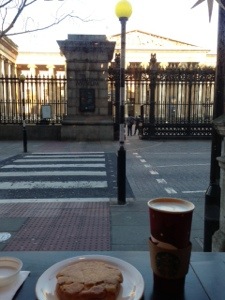
It was bloody freezing yesterday morning as I made my way to central London at 8am. I don’t normally have breakfast, but yesterday, I was desperate ๐Ÿ˜‰

20121208-230813.jpg

Today our guest tutor was Jill Dawson who’s book, Lucky Bunny I’m reading at the moment (and really enjoying!).

We all agreed that Jill’s passion and enthusiasm for writing was infectious and inspiring. A thoroughly enjoyable session where I made lots of notes (you know me! Lol). Here’s a few snippets that I wrote down that I found interesting and helpful ๐Ÿ™‚

The best way to be motivated to write is to be in love with it!

How to deal with rejection: Don’t dwell on it, it will infect your writing and the feeling of failure will go into your work.

Have a monthly goal (word count) rather than a daily or weekly one. Make your goals manageable.

Time your ideal writing session then duplicate it. Find what works for you.

Jeanette Winterson told Jill that her first novel was crap, she’s grateful for that now. Peter Carey had written 4 or 5 novels before his first that was published. Jill beleives that ALL writers have at least written 1 book that will never be published. The book you’re working on now may not be THE ONE, it might be your training ground.

Jill keeps a journal while shes writing a novel, where she reflects on how she feels and works out problems.

Learn to tolerate chaos. Get the writing done first then worry about the other things you have to do in your life!

Ask yourself when you read through your first draft – Is it alive? (Something interesting or exciting) or Is it dead? (Something boring or flat).

And finally, my favourite (and also that of my tutors!)

“Know the rules but have none.”

I made 8 pages of notes! Lol….I just couldn’t help it, she was brilliant! ๐Ÿ™‚

I love this whole idea of keeping a writing journal! Jill says it helps her work out her own processes and is like talking to herself. I’m a huge fan of journal keeping, but I’ve never tried using it just for my novel writing. Have you ever used a journal to work out problems with your writing? I’d be interested to hear if anyone has. I think I might just give it a go ๐Ÿ˜‰

The NEW WIP *drum roll*


I’m up at Faber all day today, so I’ll post about that tomorrow….in the meantime…..

Ok, after my critique recently (and my IWSG post) I’ve had to totally rethink my WIP *gulp* Thanks for all your words of encouragement on my IWSG Post, by e mail, and Facebook. Right, that’s it, I’m bucking my ideas up….rolling up my sleeves….gritting my teeth, and DOING IT!

It’s been hard trying to use the same characters and the same basic plot line to come up with a new story, but, I think I’ve cracked it. So here goes, tell me what you think. This is more a blurb than a synopsis, although, I have written a synopsis that I’ll share at a later date. It needs a bit of editing ๐Ÿ˜‰

Be careful what you wish for… At the age of 40, Laura Hopwood finds herself in desperate need of excitement. The arrival of her husbands long lost brother means that again she finds herself torn between both men. Daniel, the one she’s married to, is dependable, doting, and just plain boring. Whereas Ronnie is mysterious, moody and dangerous.

But there are two things in life that Laura loves more than anything, her daughter Ruby, and the cafe she inherited from her parents. Just how much is she prepared to risk to recapture the excitement of her youth? Did she make the wrong choice 20 years ago? And will the devastating consequences of her actions mean she’ll lose everything, including her daughter, when she finds herself having to make a similar decision 20 years later?

So that’s the basics ๐Ÿ™‚ I have to say, at the moment, I haven’t really decided what will happen (although i have a pretty good idea!). But, I’m quite excited about it! Which is a good sign yeah?

But I do have 2 problems, so I need your advice…

1. POV Last time it was in multi 3rd person, which didn’t work. So I’m thinking perhaps I should do it in 1st person? Having Laura as the protagonist. In class they suggested Ruby, as I know from personal experience what she would be going through, but, I can relate more to Laura if that makes sense.

2. Timeline Where do I start the story? It originally spanned 25 years, but I’ve cut that down to 20 (and could possibly shave a few more years off that) Do I start at the beginning, or now when the action starts and feed in back story?

So I guess I better unveil the title…

20121204-090735.jpg

I wanted a strong setting. They didn’t need to be rich accountants anymore. So now, Laura & Daniel run a cafe that Laura inherited from her parents. It’s also where she met Daniel & Ronnie in the first place, so has been the central, consistent setting throughout the whole story.

So what do you think? Honest opinions and any advice much appreciated!

Editing A Novel – Tips From Della Galton


Continuing our theme of editing this month I have a very special guest today *grins*

Today’s blog guest is the wonderful Della Galton who is a working writer (just tap her name into Amazon!!!) and agony aunt for Writers Forum Magazine. She has had over 1,000 short stories published in national magazines in the UK, and throughout the world.

Editing A Novel
So youโ€™ve written a novel at top speed โ€“ what now? Package it up and send it out to all the publishers and agents in the Writerโ€™s Handbook? Hold on just two ticks. Here are my top five editing tips.

Tip One
Put it to one side for at least a fortnight, preferably longer, a month is good. Then you can go back to it with your cool editorโ€™s head, not your passionate writerโ€™s head.

Tip Two
Read it through in its entirety. Make some notes based on these points.
Does it begin in the right place?
Is it in the right viewpoint?
Does the plot work?
Is the main character really the main character?
Is the middle saggy?
How is the dialogue โ€“ good, bad or indifferent?
Can you tell the characters apart?
Does it end well?

Tip Three
Rewrite, based on your notes.

Tip Four
Repeat Tip One.

Tip Five
Edit again, as follows:

Cut Repetition
For me, the number one fault in first drafts is repetition. I often repeat myself when I write a first draft, both in meaning and with words. I donโ€™t know whether itโ€™s they way my brain works, but Iโ€™ll very often find that Iโ€™ve repeated a word either in the same paragraph or in the one below. Itโ€™s almost as if my writing brain is saying, thatโ€™s a good word, weโ€™ll have another one of those, shall we?

I also have favourite words. Youโ€™ll have your own, but these are some of mine: just; quite; suddenly; that; and bit. I sometimes use the word search facility to go through and delete these words in my final edit.

Another way of repetition is to say the same thing in a different way.

And standing there in the sun, on that dusty afternoon Pam realised sheโ€™d never felt quite so happy in her life, which wasnโ€™t all that surprising when she thought about it. Pottering around a car boot sale was one of her favourite ways to spend a Sunday morning.

These two sentences are both telling us that Pam is happy. Only one of them is needed, although in the end I discarded both in favour of showing Pam being happy rather than directly telling the reader.

Check for overused punctuation
Iโ€™m also rather fond of dashes โ€“ I litter them through my work โ€“ and itโ€™s a difficult habit to break. Youโ€™ll find plenty besides the two in this paragraph that Iโ€™ve put in deliberately.

A good rule is that less is more. Be sparing with exclamation marks. They tend to be very visible.

Watch for telling when youโ€™ve already shown

This is effectively another form of repetition. There is no need to show the reader something and then tell them as well.

i.e. Tears streamed down Lauraโ€™s face. She was very unhappy.

Cut adverbs
Fashions change, but I am of the opinion that adverbs should be used sparingly. They tend to weaken writing, rather than strengthen it. If possible use a strong verb instead. For example, instead of saying, he ran quickly, try he raced.

Cut clichรฉs
Most clichรฉs came into being because they were the perfect way to say something. So why change them? The answer to this, I think, is that anything we hear too often is less meaningful โ€“ after a while it loses its meaning, and hence its impact, altogether.

They will certainly not make your writing original.

These are two good reasons to try and avoid them.

And finally, is it possible to over edit?
At the risk of contradicting myself, then Iโ€™d say, yes it is. Our first work tends to be a splurge of words that pour out โ€“ well they pour out on a good day! On a bad day it might feel more like pulling teeth with no anaesthetic. First drafts have a rawness about them and hopefully a sparkle. And I think that itโ€™s possible to take this sparkle out with too much editing.

Iโ€™ve seen writers who have actually managed to polish all the sparkle away from their original piece, leaving a final draft that is flat and rather emotionless. Please be careful – but in the final analysis youโ€™ll have to trust your instincts about when enough is enough. This gets much easier with time and experience.

Thank you so much Della, some great tips there!

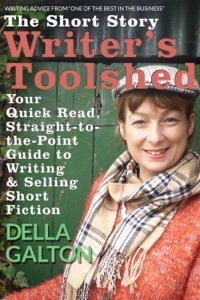
If you found that useful, (i know i did!) nip over to Amazon where you can download Della’s eBook The Short Story Writer’s Toolshed – Your Quick Read, Straight-To-The-Point Guide To Writing and Selling Short Fiction (Writer’s Toolshed Series)
20121205-161740.jpg

Originally written as a series for Writersโ€™ Forum Magazine, this snappy, no-nonsense guide has been expanded, amended and updated. Using new examples from her own published short fiction, Della Galton takes you from ‘story idea’ to ‘final edit’, and demonstrates how to construct and polish the perfect short story, ready for publication.

Ahhhh, yes, repitition lol….I have a HUGE problem with that. Did any of those tips strike a chord (CLICHE ALERT lol) with you? ๐Ÿ˜‰

I’m Collecting Stars! Blog of the Year 2012


Holly Michael has awarded me a newly created award called The Blog of the Year Award 2012. Check out the Blog Of The Year page for more info ๐Ÿ™‚

20121203-083745.jpg
As you can see there is one gold star with the possibility of six in total (because this is my first nomination).

The โ€˜rulesโ€™ for this award are simple:

1 Select the blog(s) you think deserve the โ€˜Blog of the Year 2012โ€ฒ Award

2 Write a blog post and tell us about the blog(s) you have chosen โ€” thereโ€™s no minimum or maximum number of blogs required โ€” and โ€˜presentโ€™ them with their award.

3 Please include a link back to this page โ€˜Blog of the Year 2012โ€ฒ Award โ€” http://thethoughtpalette.co.uk/our-awards/blog-of-the-year-2012-award/ and include these โ€˜rulesโ€™ in your post (please donโ€™t alter the rules or the badges!)

4 Let the blog(s) you have chosen know that you have given them this award and share the โ€˜rulesโ€™ with them.

5 You can now also join the Facebook group โ€” click โ€˜likeโ€™ on the page above โ€˜Blog of the Year 2012โ€ฒ Award Facebook group and then you can share your blog with an even wider audience.

6 As a winner of the award โ€” please add a link back to the blog that presented you with the award โ€” and then proudly display the award on your blog and sidebar โ€ฆ and start collecting starsโ€ฆ

Yes โ€” thatโ€™s right โ€” there are stars to collect!

Unlike other awards which you can only add to your blog once โ€” this award is different!

When you begin you will receive the โ€™1 starโ€™ award โ€” and every time you are given the award by another blog โ€” you can add another star!

There are a total of 6 stars to collect.

20121203-083712.jpg
Which means that you can check out your favorite blogs โ€” and even if they have already been given the award by someone else โ€” you can still bestow it on them again and help them to reach the maximum 6 stars!

So a HUGE thank you to Holly ๐Ÿ™‚

Now….who fancies collecting some stars? ๐Ÿ˜‰

I am nominating, for Blog Of The Year 2012…… Because you are all very inspiring ๐Ÿ™‚

Bridget Whelan
Kim Cox
Robin Coyle
Bridget Straub
Jennifer M Eaton
Paula Acton
Sabrina at Creativity or Crazy
C B Wentworth
CC at One Honest Writer
Joanne Phillips
Ava at Jordanna East
Dianne Gray
Florence at Ramblings From The Left
Patsy Collins
Morgen Bailey

Awwwww, I wanted to give it to ALL of you ๐Ÿ˜ฆ

Have fun people!

A very special post coming up tomorrow…. Catch Della Galton giving us her editing tips ๐Ÿ™‚

Insecure Writers Support Day – December


Bloody hell, where do I start!

Today is Insecure Writers Support Group Day, the brain child of Alex J Cavanaugh it’s where a whole lot of writers post about their insecurities, once a month, and get support from fellow participants. Seriously, I urge you to join! You will soon discover you are not alone ๐Ÿ™‚

20121128-085402.jpg
Ok, back to my post…..

If you’re a regular reader you’ll know that in 2010 (my first Nano) I ended up with a 65,000 word unfinished story entitled, But Not Forgotten. I did a spell check on it last year, and this year I’ve tinkered with it, a bit, only the first 10,000 words. I then decided a few months ago that But Not Forgotten wasn’t working and gave up on it (a previous IWSG post). But there has been something haunting me about it ever since. So I submitted the first 4,500 words of it for my critique in my Faber class (see the response here ) telling the tutor that I was unsure about it, couldn’t finish it and wanted to know whether I should.

Was that complete madness? Looking back now, probably. I’d considered it to be 2nd draft (after a spell check and slight tinkering) but, if Chris Baty is right and what you’re left with at the end of Nano is actually draft zero, then what I actually submitted was first draft lol.

The response, (you can see if you click the link above) wasn’t good and although I know, deep down in my heart, every single word they said and suggestion they made was true it’s still left me questioning whether I’m cut out for all this? Whether I can actually do it, be a writer I mean. When do you draw the line? When do you admit defeat and come to the conclusion that you will only ever be a writer as a hobbyist and that you’ll never have any commercial success? I’m not motivated by money, but, having given up an actual “job” to pursue my writing over 2 years ago I’m now feeling that perhaps that was a bad idea and that I should just go get a job?

But I got the answer I wanted, right? It’s crap, bin it! Lol

So now I have the daunting task of starting again. A new story with the same characters. A new POV and only part of the existing plot line. I don’t even know where to start! Lol. In June I have the opportunity to pitch to a room of agents and publishers….SHIT! It’s a great opportunity, and I don’t want to blow it, but will I ever have anything that’s good enough?

I’m hopefully starting on it again this week, but I said that last week! *takes deep breaths and reaches for the alcohol* I now understand why there are a lot of writers out there with drink problems lol ๐Ÿ˜‰

I hope everyone else is having a better month…..will pop over to as many as I can today ๐Ÿ™‚

Faber Session 10 – Story Vs Plot


Ok, well today, you do get a picture of last nights cake!

20121203-225925.jpg
Lemon, rosemary & olive oil cake! Oh how I will miss you once the Faber course is over *sighs whistfully* But enough of the cake porn, lets get down to the nitty gritty ๐Ÿ™‚

Tonight, the discussion centered around what the difference is between story and plot. The simplest way to show the difference is by using the example given by Nigel Watts in his excellent book Write A Novel where he says:

The King died and then the Queen died. Is a story.
The King died and then the Queen died of grief. Is a plot.

Causality distinguishes story from plot. Does that make sense?

In it’s basic terms it boils down to:
character=choices=causality

Its basically the choices, that lead to consequences, which then becomes the plot.

We talked about Christopher Bookers 7 Basic Plots and why they work.

Then talked about plot bombs and how to keep the plot moving.

A very interesting session where my critique of last week was used as an example, as what we shouldn’t be doing, i.e. throwing everything at our reader in the first 5,000 words…whoops! *snigger* ๐Ÿ™‚

So do you agree? Are there only 7 Basic plots or would you say there are more? And if you have another theory on the definition of a plot, I’d love to hear it ๐Ÿ™‚

The To Do List 3rd To 9th December


Firstly a huge thank you to Bridget Whelan for looking after my blog these last couple of days. I feel like I’ve had a mini holiday! Lol ๐Ÿ˜‰

I hope you’ve found Bridget’s tips useful, I know I have. My advice is to print them off and stick them in your notebook, that’s what I’ll be doing ๐Ÿ™‚

The 3rd and final part of Bridget’s Editing Series will be on her blog today. So do pop over to Bridget’s Blog to read the final part – Six Tips To Help You Get Your Nano Novel Ready For A Reader

Ok, now lets crack on….

It’s been a funny old week, I’ve found it hard to focus. Too much spinning round my head I guess from the Faber Critique last Monday. So the to do list was neglected ๐Ÿ˜ฆ

1. Print out rest of Sorrento Sunrise and start padding. Nope! Didn’t touch it, but, to be fair, my printer cartridges only arrived on Friday lol

2. Read BN’s manuscript (a friends Nano story). Halfway through, I am a bad Beta reader ๐Ÿ˜ฆ

3. Sort out notes from critique of But Not Forgotten. Ha ha ha, what notes? I didn’t make any!

4. Read next Faber critique piece. Done!

5. Continue with Richard Skinners book. Done!

6. Start an ideas notebook for But Not Forgotten. Done! I have made some notes, got some ideas, will share later ๐Ÿ˜‰

7. Print off and file Nano short stories. Nope! Due to printer having no ink and being lazy lol

So not a very productive week this week ๐Ÿ˜ฆ My only excuse is not being mentally 100% with it. Which means there will be some stuff carried forward ๐Ÿ˜‰

20121202-114009.jpg
1. Print out Sorrento Sunrise and file (for editing at a later date).

2. Finish BN’s manuscript – Beta reading.

3. Faber homework.

4. Do a review of Richard Skinners book and Start Nigel Watts one!

5. Continue making notes on new version of But Not Forgotten. Need to decide on POV etc. if it goes well, make a start!

6. Print off and file Nano short stories.

Also, I’ll be going back to writing my daily prompts in my notebook, which I’m actually looking forward to ๐Ÿ™‚

so what are you up to this week?

After NaNoWriMo – Editing Part 2


Part 2 of the guest post by Bridget Whelan which I’ll be making much use of this month ๐Ÿ˜‰

After NaNoWriMo
Three bite-size guides to editing and revising your NaNoWriMo novel.

PART Two

Put down everything that comes into your head and then you’re a writer. But an author is one who can judge his own stuff’s worth, without pity, and destroy most of it – Collette

Five ways of editing that first rough draft

1) Cut and cut again. Be brutal. You thought youโ€™d written 50,000 words of your NaNoWriMo novel? The harsh truth is that you probably need to ditch 20,000 of those words. Youโ€™ve got a copy of the original so you can chuck everything away knowing you have the freedom to change your mind. In fact, keep a copy of every major revision. It gives you confidence knowing that nothing is lost, and that every major change can be undone. The reality is that once paragraphs, pages and chapters have been deleted youโ€™ll wonder how they ever had a home in your manuscript.

2) Remember that adjectives donโ€™t get lonely: they do not have to travel around in pairs โ€“ the kind and pleasant man; the warm, dry day. Every time you see two together ask yourself which one you really, really need. Or if you need any.

3) Take a long, hard look at any descriptive passages, especially the ones you like the best. Samuel Johnson said that if he you ever come across a sentence he had written that struck him as being particularly elegant and finely crafted then he knew he had to cut it. It was probably written for his own enjoyment rather than because it helped the reader to understand what was going on.

4) Have you started in the right place? Classic advice is to start a story in MEDIAS RES – in the middle โ€“ in other words dive in. Have you chosen to start your NaNoWriMo novel a long time before the big event occurs? Why? If the answer is because itโ€™s a good introduction or it sets the stage, then cut. Sometimes we write a beginning more for ourselves than the reader. We are working our way into the story, getting a feel for the characters and their take on the world. You might need that introduction to get you started, the reader doesnโ€™t. So, write it if it helps you to launch a story and cut it out at the editing stage โ€“ which is now.

4) Show donโ€™t tell is the command burnt into the heart of every creative writing student, but sometimes itโ€™s ok to tell. The reader canโ€™t live through every moment. Use dialogue to dramatise the big scenes, or the moments where important elements of character are revealed. It is not for the ordinary do-you-want-a-cup-of-tea exchanges (or boring small talk at parties unless it propels the narrative in some way.)
5) Donโ€™t introduce all the characters at once. Do it one at a time with a little physical description or back story so we can remember them. (For example: Cara tucked a strand of her sand coloured behind her ear and swore softly, her previous career as an advertising writer meant she knew how to make words work for her.) Ask yourself if you have to give a name to all the minor characters. Remember that a name may be the least interesting thing about them. They could appear as their job or the function they carry out in the story. For example: the teacher saidโ€ฆ. the neighbour smiled…

20121128-081757.jpg
Courtesy of Carlos Porto freedigitalphotos

Coming up in PART THREE six tips that will help you get your NaNoWriMo novel ready for a reader. But if you want to read that post, you’ll have to pop over to Bridget’s blog tomorrow ๐Ÿ˜‰

Please leave a comment for Bridget with your thoughts and opinions, or pop over to Bridget’s Blog to say Hi

After NaNoWrimo – Editing Part 1


So how we all feeling this morning? Any Wrimo’s take it to the wire last night? We had one lady on the Kent FaceBook group who finally hit the 50k at just before 11.30pm (UK time). I couldn’t go to bed before she’d finished and validated.

So that’s it, my official ML duties are over! Awwwww, it’s been fun, but now this is where the real work starts. We have our 50,000 words, so now what? The theme this month on the old blog will be editing, and to start us off, a guest post by Bridget Whelan who teaches Creative Writing. I think this will be very handy ๐Ÿ˜‰

After NaNoWriMo
Three bite-size guides to editing and revising your NaNoWriMo novel.

PART ONE

Write drunk, edit sober – Ernest Hemingway

The relief is wonderful. Nanowrimo is over, done and dusted for another year. You have so much freedom and so much time to do other things. Some of you may even have a NanNoWriMo certificate to prove you took the challenge and won and – as long as you didnโ€™t write your name over and over again – you should be proud of yourself. Very proud.
โ€‹Of course, some of us didnโ€™t mange 50,000 words, but as long as you have more words written now than you did on November 1st youโ€™ve made an important step in your development as a writer. And you know that yourself until a small steely voice sounds in your head and says, itโ€™s all rubbish. And the bits that arenโ€™t rubbish have been done before.
โ€‹Thatโ€™s the voice that stops you writing. Thatโ€™s the voice that NaNoWriMo silences with a frenzy of activity. Thatโ€™s the voice of an editor. Itโ€™s a mean-spirited companion, dismissive of hard work and effort. It wonโ€™t offer any rewards for sticking with it, reaching goals and staying up late. All it cares about is whatโ€™s on the page and when you come to look at what youโ€™ve written during NaNoWriMo, thatโ€™s all you should be care about too. Even when it means blood on the floor.
โ€‹
Three things to do before you pick up a red pen or press delete

1) Rest and Recover. You wrote in a fever. You need the story to settle in your mind and you also need to create some distance if youโ€™re going to listen to that editorโ€™s voice. How long? At least two weeks.
2) Read. Anything except your NaNoWriMo novel. Read poetry for the language. Read cheap trashy novels you hate to learn what not to do. Read cheap trashy novels you love to learn how they captured you. Read action novels for pace and crime fiction for suspense. Read horror and speculative fiction for imagination and fairy tales for permission to push the boundaries (A brother and sister abandoned by their parents and enslaved by a female cannibal? Did you go as wild during NaNoWriMo as Hansel and Gretel?)
3) Watch the video of Kurt Vonnegut describing how to plot a best seller. It will have you laughing and thinking.

Four things to do when you read your NaNoWriMo novel again

1) Breath deeply. Dive in. If you can, try to read all the way through in one sitting. Ignore your emotions: horror, embarrassment, mild pleasure, surprise. Read with a pen in your hand and summarise every chapter (or five thousands words if it isnโ€™t broken down into chapters yet). No one will see these notes so they can be as clunky as you like. Stick to about 100 words for each summary โ€“ these are working notes and shouldnโ€™t take up too much of your writing time
2) Imagine you are being interviewed on radio. How would you describe your main character? What does your main character want? No waffle: be specific. The radio audience wonโ€™t like vague phrases about rites of passage or someone finding themselves.
3) Even if you have written The End in big bold letters and drawn a line underneath it, consider possible alternative ways of resolving the issues in your NaNoWriMo novel.
4) Ask yourself if you want to spend a lot of time living with this story and the people who inhabit it. Vikki described herself as being haunted by the story she was trying to tell in first Nanowrimo writing. Thatโ€™s a very good place for a writer to be.

Coming up in PART TWO (tomorrow) five ways of editing that first rough draft.

A great article Bridget, I will definitely be following your advice ๐Ÿ™‚

Please leave a comment for Bridget with your thoughts and opinions, or pop over to Bridget’s Blog to say Hi

NaNoWriMo – The Last Day


Today is the last day of Nano (so should that be YAY or SOB ? lol) So if you haven’t hit the 50,000 words by now you have approximately 22 hours (in the UK from the time this post went live) to pull your finger out and write!

It’s been a funny old month for me. Full of highs and lows. My first year as an official ML has been great fun. Elizabeth asked me a couple of days ago if I’d do it again next year, of course I would! ๐Ÿ™‚

I’ve met a few Wrimo’s I didn’t know before who have now become FaceBook friends and learnt that I can write 9,000 words in a day. I went on a writing retreat (which was fantastic) and discovered that Mills & Boon books are much harder to write than you think they’ll be. I also learnt that my netbook cannot be trusted and have decided that he will retire from service before next year ๐Ÿ˜‰

So what’s next? What do we now do with all those words? You have to edit *shudders* ๐Ÿ˜‰

The lovely Bridget Whelan who teaches Creative Writing, has written a series of 3 blog posts for me, all about editing. See me, I never really know where to start when it comes to editing, so I’m hoping Bridget can sort me out. You’ll find part 1 and part 2 here over the next couple of days and then part 3 will be posted to Bridget’s blog, but I’ll give you the link ๐Ÿ˜‰

So all that remains is for me to say CONGRATULATIONS! it doesn’t matter if you only wrote 10 words or 75,000 (yes, I do know someone who wrote that much and she has a baby and toddler!). Everyone who takes part in Nano and wrote something is a winner as far as I’m concerned.

So now it’s time to Party!

20121128-075016.jpg
Courtesy of Simon Howden freedigitalphotos.net

Do try to get to a TGIO Party if you can. We have ours tomorrow, I’m looking forward to it ๐Ÿ™‚

Me? I finished up with just over 55,000 words which is more than 2011 but less than 2010…..and the less said about those 65,000 words the better ๐Ÿ˜‰