Faber Session 12 – Conflict and Resolution


Blooming freezing up London Monday night so when I got off the Tube I dashed into the first coffee shop I could see spare seats in, which just happened to be Patisserie Valerie. I had a latte, a tart, and did some writing for an hour….bliss 🙂

20121210-223845.jpg

Ok, on to Monday nights session 🙂

We talked about having conflict in our stories, and the different forms of conflict there are. Internal, external, environmental, you know all this, right? And that posing a question, having a problem for your character to solve can carry the narrative all the way through your novel. That’s what makes up the plot….but what about sub plots?

I’m not sure I really understand sub plots. I mean, the general consensus is that sub plots are hard to pull off in first person…ok, I can kind of get that. And that when they are included in a 3rd person novel, that they feed into the main plot, but are independent to the main narrative.

Hmmmmm, I’m not sure I get it 😦

The only example that I knew that was given was My Fair Lady (Pygmalion) where Eliza’s father is getting married, and that would be a sub plot. Ok, well if that’s the case, my first draft of my WIP (But Not Forgotten) was all sub plot? Lol.

Help me out here guys? How would you define sub plot? Before tonight’s class I would have said it was something along the lines of, say, (sorry Jayne, your WIP was the only example I could think of) 4 women going on a cruise, and 1 of them is escaping an abusive husband. What happens to the other 3 women on board (one discovers she’s pregnant, one meets a bloke etc) are the sub plots, yeah? Or have I got that completely wrong? *groans*

Wow….this is the first lesson I’ve come away from being more confused after than I was before lol. On a lighter note, they have provided us with a rather nice Christmas Tree in our class room 🙂

20121210-225911.jpg

Dealing With Negative Reviews – J. Keller Ford


I’ll do my Faber post tomorrow, because today I have a very special guest 🙂

J. (Jenny) Keller Ford is a quirky mother of four, grand-mother and scribbler of young adult fantasy tales. She has an insatiable appetite for magic, dragons, knights and faeries, and tries to weave at least one into every story she conceives. Her muse follows her everywhere and talks incessantly, feeding her ideas for stories 24/7.

When she’s not torturing her characters mercilessly, J. Keller enjoys living in sunny Florida, listening to smooth jazz, collecting seashells, swimming, bowling, riding roller coasters and reading. Her most loyal fans (beside her family) consist of two Australian Shepherds, a mixed-breed hippy dog, and a precocious orange cat, all of whom believe J. Keller is their slave. She thinks they might be right.

20121210-131043.jpg
Jenny has recently been published in the Make Believe Anthology and today, is talking about…..

20121210-131124.jpg

Dealing With Negative Reviews

Actor Anthony Hopkins once said, “My philosophy is: It’s none of my business what people say of me and think of me. I am what I am and I do what I do. I expect nothing and accept everything. And it makes life so much easier.”

It’s a philosophy that has taken me a little time to realize, but I finally got it.

I think it’s important to understand I’ve always been someone who craved approval. I need it, even now. It must be the Leo in me coming out. I’m a perfectionist. I have to have things certain ways and I need to know I’m appreciated. It’s a part of who I am.

It’s no wonder then that I craved approval when I first started writing. I was actually terrified to throw my work out to the public, frightened by what they would think. Self-doubt and I became great friends, until the day Desire knocked on my back door. Next thing I knew, I joined an online critique site. Talk about a rollercoaster ride. Some critiques gushed with praise. Others seemed to trash everything I wrote. Self-doubt told me to stop. Desire screamed, “Do it again and again! Don’t you dare give up!” I joined other writer sites, other blogs. I met up with some fantastic beta readers who weren’t afraid to show me the flaws in my writing while keeping me motivated and focused.

Then one day this past Spring, it happened. I got my first offer of publication. I was elated. All the hard work, all the dedication, all the long hours of honing the craft of writing finally paid off. A publisher wanted MY story.

The next few months were dedicated to heavy doses of Marketing 101 and I was still riding high on the publishing wave. Then the end of November came and the ARCs (advanced reader copy) went out to various readers and reviewers. A new visitor came to see me: Anticipation, and I found myself wondering once again if ‘they’ were going to like it.

Anthologies are a double-edge sword as they contain a review of the anthology itself, and then individual reviews. MAKE BELIEVE has garnered at least twenty reviews and has phenomenal ratings. I think I can speak for all six authors when I say we’re thrilled to see the anthology so well received.

As for my story, The Amulet of Ormisez? Well, let’s just say it hasn’t been one of the ‘better’ received stories. Everything I tried so hard to do right turned out so wrong. Self-doubt cackled and sat her big rear-end on top of me and wouldn’t move…that is until I got a few virtual smacks along with a few stern words from my beta readers and my daughter. They reminded me that my publisher, who is VERY picky about what they publish, believed in my story enough to publish it. It took my daughter to remind me that a lot of people HATED Harry Potter and many reviewers claimed there were plot holes all over the place. “Ha!” she said. “Do you think Rowling cares what they think?” Another friend reminded me that even Stephen King is not a stranger to bad reviews, but does that stop him from writing? The kicker came when a friend said to me, “Stop caring about what other people think. The only opinion about you that matters is your own.” Something clicked.

So, here I am, a published author and stronger and wiser for the wear. I’ve weathered the ‘review’ storm of my first published piece, and you know what, it wasn’t that bad. Some people loved my story. Some didn’t. That’s okay. My writing isn’t going to appeal to everyone nor should it. As the incomparable Anthony Hopkins said, “It’s none of my business what people say of me and think of me. I am what I am and I do what I do. I expect nothing and accept everything. And it makes life so much easier.”

Amen, Mr. Hopkins. Amen.

Thank you so much Jenny, I really enjoyed that. And like you say, even Stephen King gets bad reviews! Are you dreading that first bad review? Have you had one? How did you deal with it? I seriously think I will cry lol, my critique at Faber was bad enough!

Check out Jenny’s Excellent Blog (I’ve been a follower for a while now) and if you’d like to purchase a copy of Make Believe its available now on Amazon.com and Amazon.co.uk as a download for Kindle. I’ve already added it to my wish list 😉

The To Do List 10th to 16th December


I spent most of yesterday trying to catch up with all your blogs and e mails. I’m sorry, but I made much use of the “like” button lol 😉

I’m feeling a bit worn out at the moment. I think I’ve just been over doing it, so I’m looking forward to a break at Christmas.

Last weeks To Do List was more successful than I thought it would be now I’ve a tally gone through it again 🙂

1. Print out Sorrento Sunrise and file (for editing at a later date). Done!

2. Finish BN’s manuscript – Beta reading. Still reading 🙂

3. Faber homework. Done!

4. Do a review of Richard Skinners book and Start Nigel Watts one! Done!

5. Continue making notes on new version of But Not Forgotten. Need to decide on POV etc. if it goes well, make a start! Ive made a start. Written 500 words, the beginning, in 1st person POV….now, I just need to do the same piece in 3rd person and see which works better.

6. Print off and file Nano short stories. Done!

This weeks list looks like this…..

20121209-141123.jpg
1. Finish Beta reading BN’s piece.

2. Faber homework.

3. Continue with Nigel Watts book.

4. Edit and prepare The Last Word Cafe Synopsis for Thursdays event.

5. Continue making notes on The Last Word Cafe and do a section in 3rd person.

6. Go through Faber notes re The Last Word Cafe.

I have a really busy week coming up…I’m out Monday night, Wednesday Night, Thursday night and then all day Saturday and most of Sunday….so wish me luck! Lol

What are your writing plans this week?

Faber Session 11 – Guest Tutor Jill Dawson


I’ve had a real hectic few days so I am behind with blog reading….I will catch up today I promise, so bear with me. 🙂

It was bloody freezing yesterday morning as I made my way to central London at 8am. I don’t normally have breakfast, but yesterday, I was desperate 😉

20121208-230813.jpg

Today our guest tutor was Jill Dawson who’s book, Lucky Bunny I’m reading at the moment (and really enjoying!).

We all agreed that Jill’s passion and enthusiasm for writing was infectious and inspiring. A thoroughly enjoyable session where I made lots of notes (you know me! Lol). Here’s a few snippets that I wrote down that I found interesting and helpful 🙂

The best way to be motivated to write is to be in love with it!

How to deal with rejection: Don’t dwell on it, it will infect your writing and the feeling of failure will go into your work.

Have a monthly goal (word count) rather than a daily or weekly one. Make your goals manageable.

Time your ideal writing session then duplicate it. Find what works for you.

Jeanette Winterson told Jill that her first novel was crap, she’s grateful for that now. Peter Carey had written 4 or 5 novels before his first that was published. Jill beleives that ALL writers have at least written 1 book that will never be published. The book you’re working on now may not be THE ONE, it might be your training ground.

Jill keeps a journal while shes writing a novel, where she reflects on how she feels and works out problems.

Learn to tolerate chaos. Get the writing done first then worry about the other things you have to do in your life!

Ask yourself when you read through your first draft – Is it alive? (Something interesting or exciting) or Is it dead? (Something boring or flat).

And finally, my favourite (and also that of my tutors!)

“Know the rules but have none.”

I made 8 pages of notes! Lol….I just couldn’t help it, she was brilliant! 🙂

I love this whole idea of keeping a writing journal! Jill says it helps her work out her own processes and is like talking to herself. I’m a huge fan of journal keeping, but I’ve never tried using it just for my novel writing. Have you ever used a journal to work out problems with your writing? I’d be interested to hear if anyone has. I think I might just give it a go 😉

The NEW WIP *drum roll*


I’m up at Faber all day today, so I’ll post about that tomorrow….in the meantime…..

Ok, after my critique recently (and my IWSG post) I’ve had to totally rethink my WIP *gulp* Thanks for all your words of encouragement on my IWSG Post, by e mail, and Facebook. Right, that’s it, I’m bucking my ideas up….rolling up my sleeves….gritting my teeth, and DOING IT!

It’s been hard trying to use the same characters and the same basic plot line to come up with a new story, but, I think I’ve cracked it. So here goes, tell me what you think. This is more a blurb than a synopsis, although, I have written a synopsis that I’ll share at a later date. It needs a bit of editing 😉

Be careful what you wish for… At the age of 40, Laura Hopwood finds herself in desperate need of excitement. The arrival of her husbands long lost brother means that again she finds herself torn between both men. Daniel, the one she’s married to, is dependable, doting, and just plain boring. Whereas Ronnie is mysterious, moody and dangerous.

But there are two things in life that Laura loves more than anything, her daughter Ruby, and the cafe she inherited from her parents. Just how much is she prepared to risk to recapture the excitement of her youth? Did she make the wrong choice 20 years ago? And will the devastating consequences of her actions mean she’ll lose everything, including her daughter, when she finds herself having to make a similar decision 20 years later?

So that’s the basics 🙂 I have to say, at the moment, I haven’t really decided what will happen (although i have a pretty good idea!). But, I’m quite excited about it! Which is a good sign yeah?

But I do have 2 problems, so I need your advice…

1. POV Last time it was in multi 3rd person, which didn’t work. So I’m thinking perhaps I should do it in 1st person? Having Laura as the protagonist. In class they suggested Ruby, as I know from personal experience what she would be going through, but, I can relate more to Laura if that makes sense.

2. Timeline Where do I start the story? It originally spanned 25 years, but I’ve cut that down to 20 (and could possibly shave a few more years off that) Do I start at the beginning, or now when the action starts and feed in back story?

So I guess I better unveil the title…

20121204-090735.jpg

I wanted a strong setting. They didn’t need to be rich accountants anymore. So now, Laura & Daniel run a cafe that Laura inherited from her parents. It’s also where she met Daniel & Ronnie in the first place, so has been the central, consistent setting throughout the whole story.

So what do you think? Honest opinions and any advice much appreciated!

Editing A Novel – Tips From Della Galton


Continuing our theme of editing this month I have a very special guest today *grins*

Today’s blog guest is the wonderful Della Galton who is a working writer (just tap her name into Amazon!!!) and agony aunt for Writers Forum Magazine. She has had over 1,000 short stories published in national magazines in the UK, and throughout the world.

Editing A Novel
So you’ve written a novel at top speed – what now? Package it up and send it out to all the publishers and agents in the Writer’s Handbook? Hold on just two ticks. Here are my top five editing tips.

Tip One
Put it to one side for at least a fortnight, preferably longer, a month is good. Then you can go back to it with your cool editor’s head, not your passionate writer’s head.

Tip Two
Read it through in its entirety. Make some notes based on these points.
Does it begin in the right place?
Is it in the right viewpoint?
Does the plot work?
Is the main character really the main character?
Is the middle saggy?
How is the dialogue – good, bad or indifferent?
Can you tell the characters apart?
Does it end well?

Tip Three
Rewrite, based on your notes.

Tip Four
Repeat Tip One.

Tip Five
Edit again, as follows:

Cut Repetition
For me, the number one fault in first drafts is repetition. I often repeat myself when I write a first draft, both in meaning and with words. I don’t know whether it’s they way my brain works, but I’ll very often find that I’ve repeated a word either in the same paragraph or in the one below. It’s almost as if my writing brain is saying, that’s a good word, we’ll have another one of those, shall we?

I also have favourite words. You’ll have your own, but these are some of mine: just; quite; suddenly; that; and bit. I sometimes use the word search facility to go through and delete these words in my final edit.

Another way of repetition is to say the same thing in a different way.

And standing there in the sun, on that dusty afternoon Pam realised she’d never felt quite so happy in her life, which wasn’t all that surprising when she thought about it. Pottering around a car boot sale was one of her favourite ways to spend a Sunday morning.

These two sentences are both telling us that Pam is happy. Only one of them is needed, although in the end I discarded both in favour of showing Pam being happy rather than directly telling the reader.

Check for overused punctuation
I’m also rather fond of dashes – I litter them through my work – and it’s a difficult habit to break. You’ll find plenty besides the two in this paragraph that I’ve put in deliberately.

A good rule is that less is more. Be sparing with exclamation marks. They tend to be very visible.

Watch for telling when you’ve already shown

This is effectively another form of repetition. There is no need to show the reader something and then tell them as well.

i.e. Tears streamed down Laura’s face. She was very unhappy.

Cut adverbs
Fashions change, but I am of the opinion that adverbs should be used sparingly. They tend to weaken writing, rather than strengthen it. If possible use a strong verb instead. For example, instead of saying, he ran quickly, try he raced.

Cut clichés
Most clichés came into being because they were the perfect way to say something. So why change them? The answer to this, I think, is that anything we hear too often is less meaningful – after a while it loses its meaning, and hence its impact, altogether.

They will certainly not make your writing original.

These are two good reasons to try and avoid them.

And finally, is it possible to over edit?
At the risk of contradicting myself, then I’d say, yes it is. Our first work tends to be a splurge of words that pour out – well they pour out on a good day! On a bad day it might feel more like pulling teeth with no anaesthetic. First drafts have a rawness about them and hopefully a sparkle. And I think that it’s possible to take this sparkle out with too much editing.

I’ve seen writers who have actually managed to polish all the sparkle away from their original piece, leaving a final draft that is flat and rather emotionless. Please be careful – but in the final analysis you’ll have to trust your instincts about when enough is enough. This gets much easier with time and experience.

Thank you so much Della, some great tips there!

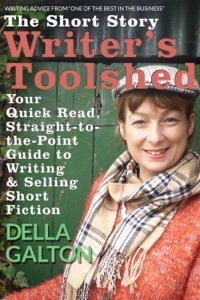
If you found that useful, (i know i did!) nip over to Amazon where you can download Della’s eBook The Short Story Writer’s Toolshed – Your Quick Read, Straight-To-The-Point Guide To Writing and Selling Short Fiction (Writer’s Toolshed Series)
20121205-161740.jpg

Originally written as a series for Writers’ Forum Magazine, this snappy, no-nonsense guide has been expanded, amended and updated. Using new examples from her own published short fiction, Della Galton takes you from ‘story idea’ to ‘final edit’, and demonstrates how to construct and polish the perfect short story, ready for publication.

Ahhhh, yes, repitition lol….I have a HUGE problem with that. Did any of those tips strike a chord (CLICHE ALERT lol) with you? 😉

I’m Collecting Stars! Blog of the Year 2012


Holly Michael has awarded me a newly created award called The Blog of the Year Award 2012. Check out the Blog Of The Year page for more info 🙂

20121203-083745.jpg
As you can see there is one gold star with the possibility of six in total (because this is my first nomination).

The ‘rules’ for this award are simple:

1 Select the blog(s) you think deserve the ‘Blog of the Year 2012′ Award

2 Write a blog post and tell us about the blog(s) you have chosen — there’s no minimum or maximum number of blogs required — and ‘present’ them with their award.

3 Please include a link back to this page ‘Blog of the Year 2012′ Award — http://thethoughtpalette.co.uk/our-awards/blog-of-the-year-2012-award/ and include these ‘rules’ in your post (please don’t alter the rules or the badges!)

4 Let the blog(s) you have chosen know that you have given them this award and share the ‘rules’ with them.

5 You can now also join the Facebook group — click ‘like’ on the page above ‘Blog of the Year 2012′ Award Facebook group and then you can share your blog with an even wider audience.

6 As a winner of the award — please add a link back to the blog that presented you with the award — and then proudly display the award on your blog and sidebar … and start collecting stars…

Yes — that’s right — there are stars to collect!

Unlike other awards which you can only add to your blog once — this award is different!

When you begin you will receive the ’1 star’ award — and every time you are given the award by another blog — you can add another star!

There are a total of 6 stars to collect.

20121203-083712.jpg
Which means that you can check out your favorite blogs — and even if they have already been given the award by someone else — you can still bestow it on them again and help them to reach the maximum 6 stars!

So a HUGE thank you to Holly 🙂

Now….who fancies collecting some stars? 😉

I am nominating, for Blog Of The Year 2012…… Because you are all very inspiring 🙂

Bridget Whelan
Kim Cox
Robin Coyle
Bridget Straub
Jennifer M Eaton
Paula Acton
Sabrina at Creativity or Crazy
C B Wentworth
CC at One Honest Writer
Joanne Phillips
Ava at Jordanna East
Dianne Gray
Florence at Ramblings From The Left
Patsy Collins
Morgen Bailey

Awwwww, I wanted to give it to ALL of you 😦

Have fun people!

A very special post coming up tomorrow…. Catch Della Galton giving us her editing tips 🙂

Insecure Writers Support Day – December


Bloody hell, where do I start!

Today is Insecure Writers Support Group Day, the brain child of Alex J Cavanaugh it’s where a whole lot of writers post about their insecurities, once a month, and get support from fellow participants. Seriously, I urge you to join! You will soon discover you are not alone 🙂

20121128-085402.jpg
Ok, back to my post…..

If you’re a regular reader you’ll know that in 2010 (my first Nano) I ended up with a 65,000 word unfinished story entitled, But Not Forgotten. I did a spell check on it last year, and this year I’ve tinkered with it, a bit, only the first 10,000 words. I then decided a few months ago that But Not Forgotten wasn’t working and gave up on it (a previous IWSG post). But there has been something haunting me about it ever since. So I submitted the first 4,500 words of it for my critique in my Faber class (see the response here ) telling the tutor that I was unsure about it, couldn’t finish it and wanted to know whether I should.

Was that complete madness? Looking back now, probably. I’d considered it to be 2nd draft (after a spell check and slight tinkering) but, if Chris Baty is right and what you’re left with at the end of Nano is actually draft zero, then what I actually submitted was first draft lol.

The response, (you can see if you click the link above) wasn’t good and although I know, deep down in my heart, every single word they said and suggestion they made was true it’s still left me questioning whether I’m cut out for all this? Whether I can actually do it, be a writer I mean. When do you draw the line? When do you admit defeat and come to the conclusion that you will only ever be a writer as a hobbyist and that you’ll never have any commercial success? I’m not motivated by money, but, having given up an actual “job” to pursue my writing over 2 years ago I’m now feeling that perhaps that was a bad idea and that I should just go get a job?

But I got the answer I wanted, right? It’s crap, bin it! Lol

So now I have the daunting task of starting again. A new story with the same characters. A new POV and only part of the existing plot line. I don’t even know where to start! Lol. In June I have the opportunity to pitch to a room of agents and publishers….SHIT! It’s a great opportunity, and I don’t want to blow it, but will I ever have anything that’s good enough?

I’m hopefully starting on it again this week, but I said that last week! *takes deep breaths and reaches for the alcohol* I now understand why there are a lot of writers out there with drink problems lol 😉

I hope everyone else is having a better month…..will pop over to as many as I can today 🙂

Faber Session 10 – Story Vs Plot


Ok, well today, you do get a picture of last nights cake!

20121203-225925.jpg
Lemon, rosemary & olive oil cake! Oh how I will miss you once the Faber course is over *sighs whistfully* But enough of the cake porn, lets get down to the nitty gritty 🙂

Tonight, the discussion centered around what the difference is between story and plot. The simplest way to show the difference is by using the example given by Nigel Watts in his excellent book Write A Novel where he says:

The King died and then the Queen died. Is a story.
The King died and then the Queen died of grief. Is a plot.

Causality distinguishes story from plot. Does that make sense?

In it’s basic terms it boils down to:
character=choices=causality

Its basically the choices, that lead to consequences, which then becomes the plot.

We talked about Christopher Bookers 7 Basic Plots and why they work.

Then talked about plot bombs and how to keep the plot moving.

A very interesting session where my critique of last week was used as an example, as what we shouldn’t be doing, i.e. throwing everything at our reader in the first 5,000 words…whoops! *snigger* 🙂

So do you agree? Are there only 7 Basic plots or would you say there are more? And if you have another theory on the definition of a plot, I’d love to hear it 🙂

The To Do List 3rd To 9th December


Firstly a huge thank you to Bridget Whelan for looking after my blog these last couple of days. I feel like I’ve had a mini holiday! Lol 😉

I hope you’ve found Bridget’s tips useful, I know I have. My advice is to print them off and stick them in your notebook, that’s what I’ll be doing 🙂

The 3rd and final part of Bridget’s Editing Series will be on her blog today. So do pop over to Bridget’s Blog to read the final part – Six Tips To Help You Get Your Nano Novel Ready For A Reader

Ok, now lets crack on….

It’s been a funny old week, I’ve found it hard to focus. Too much spinning round my head I guess from the Faber Critique last Monday. So the to do list was neglected 😦

1. Print out rest of Sorrento Sunrise and start padding. Nope! Didn’t touch it, but, to be fair, my printer cartridges only arrived on Friday lol

2. Read BN’s manuscript (a friends Nano story). Halfway through, I am a bad Beta reader 😦

3. Sort out notes from critique of But Not Forgotten. Ha ha ha, what notes? I didn’t make any!

4. Read next Faber critique piece. Done!

5. Continue with Richard Skinners book. Done!

6. Start an ideas notebook for But Not Forgotten. Done! I have made some notes, got some ideas, will share later 😉

7. Print off and file Nano short stories. Nope! Due to printer having no ink and being lazy lol

So not a very productive week this week 😦 My only excuse is not being mentally 100% with it. Which means there will be some stuff carried forward 😉

20121202-114009.jpg
1. Print out Sorrento Sunrise and file (for editing at a later date).

2. Finish BN’s manuscript – Beta reading.

3. Faber homework.

4. Do a review of Richard Skinners book and Start Nigel Watts one!

5. Continue making notes on new version of But Not Forgotten. Need to decide on POV etc. if it goes well, make a start!

6. Print off and file Nano short stories.

Also, I’ll be going back to writing my daily prompts in my notebook, which I’m actually looking forward to 🙂

so what are you up to this week?