Faber Session 11 – Guest Tutor Jill Dawson


I’ve had a real hectic few days so I am behind with blog reading….I will catch up today I promise, so bear with me. 🙂

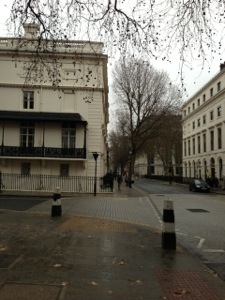
It was bloody freezing yesterday morning as I made my way to central London at 8am. I don’t normally have breakfast, but yesterday, I was desperate 😉

20121208-230813.jpg

Today our guest tutor was Jill Dawson who’s book, Lucky Bunny I’m reading at the moment (and really enjoying!).

We all agreed that Jill’s passion and enthusiasm for writing was infectious and inspiring. A thoroughly enjoyable session where I made lots of notes (you know me! Lol). Here’s a few snippets that I wrote down that I found interesting and helpful 🙂

The best way to be motivated to write is to be in love with it!

How to deal with rejection: Don’t dwell on it, it will infect your writing and the feeling of failure will go into your work.

Have a monthly goal (word count) rather than a daily or weekly one. Make your goals manageable.

Time your ideal writing session then duplicate it. Find what works for you.

Jeanette Winterson told Jill that her first novel was crap, she’s grateful for that now. Peter Carey had written 4 or 5 novels before his first that was published. Jill beleives that ALL writers have at least written 1 book that will never be published. The book you’re working on now may not be THE ONE, it might be your training ground.

Jill keeps a journal while shes writing a novel, where she reflects on how she feels and works out problems.

Learn to tolerate chaos. Get the writing done first then worry about the other things you have to do in your life!

Ask yourself when you read through your first draft – Is it alive? (Something interesting or exciting) or Is it dead? (Something boring or flat).

And finally, my favourite (and also that of my tutors!)

“Know the rules but have none.”

I made 8 pages of notes! Lol….I just couldn’t help it, she was brilliant! 🙂

I love this whole idea of keeping a writing journal! Jill says it helps her work out her own processes and is like talking to herself. I’m a huge fan of journal keeping, but I’ve never tried using it just for my novel writing. Have you ever used a journal to work out problems with your writing? I’d be interested to hear if anyone has. I think I might just give it a go 😉

Editing A Novel – Tips From Della Galton


Continuing our theme of editing this month I have a very special guest today *grins*

Today’s blog guest is the wonderful Della Galton who is a working writer (just tap her name into Amazon!!!) and agony aunt for Writers Forum Magazine. She has had over 1,000 short stories published in national magazines in the UK, and throughout the world.

Editing A Novel
So you’ve written a novel at top speed – what now? Package it up and send it out to all the publishers and agents in the Writer’s Handbook? Hold on just two ticks. Here are my top five editing tips.

Tip One
Put it to one side for at least a fortnight, preferably longer, a month is good. Then you can go back to it with your cool editor’s head, not your passionate writer’s head.

Tip Two
Read it through in its entirety. Make some notes based on these points.
Does it begin in the right place?
Is it in the right viewpoint?
Does the plot work?
Is the main character really the main character?
Is the middle saggy?
How is the dialogue – good, bad or indifferent?
Can you tell the characters apart?
Does it end well?

Tip Three
Rewrite, based on your notes.

Tip Four
Repeat Tip One.

Tip Five
Edit again, as follows:

Cut Repetition
For me, the number one fault in first drafts is repetition. I often repeat myself when I write a first draft, both in meaning and with words. I don’t know whether it’s they way my brain works, but I’ll very often find that I’ve repeated a word either in the same paragraph or in the one below. It’s almost as if my writing brain is saying, that’s a good word, we’ll have another one of those, shall we?

I also have favourite words. You’ll have your own, but these are some of mine: just; quite; suddenly; that; and bit. I sometimes use the word search facility to go through and delete these words in my final edit.

Another way of repetition is to say the same thing in a different way.

And standing there in the sun, on that dusty afternoon Pam realised she’d never felt quite so happy in her life, which wasn’t all that surprising when she thought about it. Pottering around a car boot sale was one of her favourite ways to spend a Sunday morning.

These two sentences are both telling us that Pam is happy. Only one of them is needed, although in the end I discarded both in favour of showing Pam being happy rather than directly telling the reader.

Check for overused punctuation
I’m also rather fond of dashes – I litter them through my work – and it’s a difficult habit to break. You’ll find plenty besides the two in this paragraph that I’ve put in deliberately.

A good rule is that less is more. Be sparing with exclamation marks. They tend to be very visible.

Watch for telling when you’ve already shown

This is effectively another form of repetition. There is no need to show the reader something and then tell them as well.

i.e. Tears streamed down Laura’s face. She was very unhappy.

Cut adverbs
Fashions change, but I am of the opinion that adverbs should be used sparingly. They tend to weaken writing, rather than strengthen it. If possible use a strong verb instead. For example, instead of saying, he ran quickly, try he raced.

Cut clichés
Most clichés came into being because they were the perfect way to say something. So why change them? The answer to this, I think, is that anything we hear too often is less meaningful – after a while it loses its meaning, and hence its impact, altogether.

They will certainly not make your writing original.

These are two good reasons to try and avoid them.

And finally, is it possible to over edit?
At the risk of contradicting myself, then I’d say, yes it is. Our first work tends to be a splurge of words that pour out – well they pour out on a good day! On a bad day it might feel more like pulling teeth with no anaesthetic. First drafts have a rawness about them and hopefully a sparkle. And I think that it’s possible to take this sparkle out with too much editing.

I’ve seen writers who have actually managed to polish all the sparkle away from their original piece, leaving a final draft that is flat and rather emotionless. Please be careful – but in the final analysis you’ll have to trust your instincts about when enough is enough. This gets much easier with time and experience.

Thank you so much Della, some great tips there!

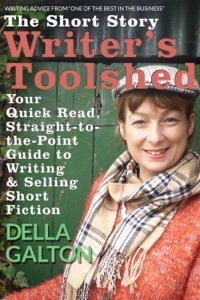
If you found that useful, (i know i did!) nip over to Amazon where you can download Della’s eBook The Short Story Writer’s Toolshed – Your Quick Read, Straight-To-The-Point Guide To Writing and Selling Short Fiction (Writer’s Toolshed Series)
20121205-161740.jpg

Originally written as a series for Writers’ Forum Magazine, this snappy, no-nonsense guide has been expanded, amended and updated. Using new examples from her own published short fiction, Della Galton takes you from ‘story idea’ to ‘final edit’, and demonstrates how to construct and polish the perfect short story, ready for publication.

Ahhhh, yes, repitition lol….I have a HUGE problem with that. Did any of those tips strike a chord (CLICHE ALERT lol) with you? 😉

Faber Session 10 – Story Vs Plot


Ok, well today, you do get a picture of last nights cake!

20121203-225925.jpg
Lemon, rosemary & olive oil cake! Oh how I will miss you once the Faber course is over *sighs whistfully* But enough of the cake porn, lets get down to the nitty gritty 🙂

Tonight, the discussion centered around what the difference is between story and plot. The simplest way to show the difference is by using the example given by Nigel Watts in his excellent book Write A Novel where he says:

The King died and then the Queen died. Is a story.
The King died and then the Queen died of grief. Is a plot.

Causality distinguishes story from plot. Does that make sense?

In it’s basic terms it boils down to:
character=choices=causality

Its basically the choices, that lead to consequences, which then becomes the plot.

We talked about Christopher Bookers 7 Basic Plots and why they work.

Then talked about plot bombs and how to keep the plot moving.

A very interesting session where my critique of last week was used as an example, as what we shouldn’t be doing, i.e. throwing everything at our reader in the first 5,000 words…whoops! *snigger* 🙂

So do you agree? Are there only 7 Basic plots or would you say there are more? And if you have another theory on the definition of a plot, I’d love to hear it 🙂

But Not Forgotten Needs Forgetting


Ok, what can I say about the critique *laughs hysterically*

If I just say that it looks like 65,000 words will be going in the bin within the next couple of days does that indicate what they thought? 😉 (a metaphorical bin of course!)

Seriously, I knew it was a mess, which was why I decided to use that piece. I just didn’t realise how much of a mess it was 😦

I knew I’d tied myself up in knots, I knew that was why I hadn’t been able to come up with an ending, but, what I was hoping was that I could tinker with it, make it better. What I didn’t expect was to find that the general consensus is/was to start from scratch!

A different angle, a different POV, don’t start with the suicide, in fact, don’t kill him off….WOAH! Concentrate on one aspect of the story and forget the rest! OMFG!!!!!!! I WAS NOT EXPECTING THAT!

So now what? Complete restructuring that’s what! A completely new novel really, only using the same characters and only part of the original plot line *slumps*

I don’t know if I have the energy!

Don’t get me wrong, everyone was helpful and sympathetic, but I came away thinking perhaps I’m not cut out for this, and what the hell am I doing in this class? Be prepared for a major self pity trip post on IWSD next month, honestly 🙂

I went for a Spa day today. I was going to cancel because all I wanted to do was sit in my jim jams, drink hot chocolate and sulk lol. But, I made the effort, went, and had my nails painted. I went for a walk and contemplated stuff. It was a nice day 🙂

20121127-200424.jpg

I’m signing out with Edwin Collins

I need to think……

Faber Session 9 – Dialogue


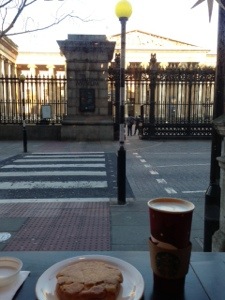
Ok, well coffee and cake was enjoyed at The British Museum last night. Lemon drizzle which was rather nice. So I sat for an hour, reading my book, nursing a latte and looking at this view 🙂

20121126-231512.jpg

Tonight’s class was all about dialogue…some of my notes:

Limit speech tags to the minimum.

Pinter went on bus rides and recorded conversations.

It has to serve a purpose: move the plot along, raise a question or show something about the character.

What isn’t said is very important. Use silence and remember its often what’s not said that gives more away.

Give your characters verbal ticks to make them more realistic.

Remember to use body language. A character could be saying one thing verbally, but their body language saying the complete opposite.

We then had to do 3 exercises (writing dialogue) which were very interesting, and bloody hard! Lol

It’s funny because Stephen King said that dialogue is written best by writers who enjoy talking and listening to others. Do you agree? Do you enjoy writing dialogue? It seems to be something writers either love or hate!

Will post tomorrow about my critique when I’ve recovered and had chance to absorb it all lol. I’m off to a Spa Day today 🙂

Today’s The Day People


Sorry for the lateness of today’s blog pst (and yesterday’s) but I’ve not been at home, back now though 😉

So today the Nanowrimo Verification system kicks in. Yep, that means that all of you who have reached the 50K mark can now upload your words and have them verified, and be officially classed a winner 🙂

I’ve just done mine, so I am officially a winner!

20121125-163732.jpg
I feel a little bit guilty though, I didn’t do Nano this year the way it should be done. Some of you already know, but for those of you who don’t I ended up finishing my Mills & Boon experiment at 20,000 words. I briefly thought about giving up, but I wanted to complete the challenge. So the next 30,000 words were short stories.

But I tell you what….it was is probably the most enjoyable Nano I’ve participated in. To the point where I’m considering, next year, to do a short story a day for November. I guess it goes back to me being an ideas person. I love creating characters, creating crap to throw at them, and then, I kinda get bored. But I don’t consider myself a good short story writer. My endings suck lol. I can come up with the scenarios, the characters, but then I don’t know how to resolve the story, in a satisfying manner. I don’t resort to “and then he/she woke up” as a final line, but I’ve been tempted lol.

So congratulations to all the Nano winners, it’s been a blast! And those of you who haven’t finished yet,GO FOR IT you have 5 days!

So now that we have all these extra words that we didn’t have last month What’s the plan? What will you be doing with your Nano Words? Me, I’ll be fiddling with Sorrento Sunrise and trying to find 30,000 words to pad it out with lol 😉

Faber Session 8 – Guest Tutor Mick Jackson


Arrived in a foggy rainy London 😦 That’ll teach me to wear suede boots! Lol

So I arrived at class with wet feet where we went straight into a discussion/talk by Mick Jackson which was all about Pace & Style.

20121124-202901.jpg
A few of the things I took away from the session:

Style seems to be more important to reviewers and creative writing tutors.

style should develop naturally. Each writer has their own style.

Writing is like a game of tennis between the subconscious mind and the conscious mind.

Can you reproduce another writers style?

Pace is the speed of the narrative.

Adding back story can slow down the pace if not weaved into the story.

Attach little details to the stream of narrative. It shouldn’t stand out.

Reading your work aloud can pinpoint problems in pace, but it can also help you establish if you have a set style.

A fascinating session, and now, I’m sitting in a hotel room enjoying some chill out time 😉 So if I’m quiet, you know why. I’ll catch up with you all tomorrow 🙂

20121124-204551.jpg
Do you think you have a style? I think I can see a style developing within my work but I will definitely be reading my work out loud from now on 😉

The Artist Manifesto


Jeff Goins told me to share this, so I will 🙂

20121114-153521.jpg

Soooooo…..

THE TIME IS NOW!

What creative thing will you do today?

Have You Voted?


Every year, the brilliant website for writers Write To Done asks readers to nominate their favourite “writerly” blog. Winners get to display a nice shiny button on their blog to say they are in the top 10 blogs for writers and smile lots.

So have you voted?

I have 🙂

20121114-155420.jpg

Oh go on, it takes 2 minutes just to post a link to your favourite blog in the comments. I’m sure you know loads of blogs you think deserve to win. Support all our marvellous writing bloggers 🙂

Will you be voting?

In other news….I’VE DONE IT! I’VE HIT THE 50K FOR NANO! GO ME!

Where The Ideas Are And How To Get Them


No actual post today people, but I’m really excited!!!! My article went live on the Faber Website last night *grins* 🙂

So if you’d like to have a read (please do!) check out my article which they’ve entitled Get Inspired. Stop Waiting Around which is all about where i find my ideas.

20121120-214438.jpg
Photo courtesy of winnond at freedigitalphotos

Read it here>>>>> Get Inspired. Stop Waiting Around.

Pop back and tell me what you thought 🙂