U is for Updike


20130423-092353.jpg

John Hoyer Updike was born in 1932 in Pennsylvania and it was his mother’s own attempts to be a published writer that inspired him to do the same.

He graduated from Harvard with a degree in English but his early ambitions to become a cartoonist led him to study Art at Oxford University. When he returned to the US the family moved to New York and it was there that his writing career began, initially as a full time member of staff at The New Yorker. He wrote poetry and short stories that were published in the magazine, and later this work was published in book form as short story collections.

His connection with The New Yorker (a relationship that continued many years after he left their employment) gave him access to readers and enabled him to publish his first novel in 1960, Rabbit – Run, the first in a series of 6 books. Updike enjoyed working in series and produced 5 during his lifetime. He worked in a wide array of genres, including fiction (30 novels and 17 short story collections), poetry, essays, a play, and a memoir. He won many awards including two Pulitzer Prizes.

Often compared to Nabokov, his style of writing was described as “rich” and carefully crafted. The constant theme of his work was religion, sex, America and death. He wrote nostalgically about small town America.

He died in Massachusetts in 2009 of lung cancer at the age of 76.

Updike was a Literary Critic and in one of his Essays he lists his personal rules for criticism.

1. “Try to understand what the author wished to do, and do not blame him for not achieving what he did not attempt.”

2. “Give enough direct quotation — at least one extended passage — of the book’s prose so the review’s reader can form his own impression, can get his own taste.”

3. “Confirm your description of the book with quotation from the book, if only phrase-long, rather than proceeding by fuzzy précis.”

4. “Go easy on plot summary, and do not give away the ending.”

5. “If the book is judged deficient, cite a successful example along the same lines, from the author’s œuvre or elsewhere. Try to understand the failure. Sure it’s his and not yours?”

“To these concrete five might be added a vaguer sixth, having to do with maintaining a chemical purity in the reaction between product and appraiser. Do not accept for review a book you are predisposed to dislike, or committed by friendship to like. Do not imagine yourself a caretaker of any tradition, an enforcer of any party standards, a warrior in any ideological battle, a corrections officer of any kind. Never, never … try to put the author “in his place,” making of him a pawn in a contest with other reviewers. Review the book, not the reputation. Submit to whatever spell, weak or strong, is being cast. Better to praise and share than blame and ban. The communion between reviewer and his public is based upon the presumption of certain possible joys of reading, and all our discriminations should curve toward that end.”

My favourite Updike quotes:

“Creativity is merely a plus name for regular activity. Any activity becomes creative when the doer cares about doing it right, or better.”

“A narrative is like a room on whose walls a number of false doors have been painted; while within the narrative, we have many apparent choices of exit, but when the author leads us to one particular door, we know it is the right one because it opens.”

“Each morning my characters greet me with misty faces willing, though chilled, to muster for another days progress through the dazzling quicksand the marsh of blank paper.”

“It’s always a push to get up the stairs, to sit down and go to work. You’d rather do almost anything, read the paper again, write some letters, play with your old dust jackets, any number of things you’d rather do than tackle that empty page, because what you do on the page is you, your ticket to all the good luck you’ve enjoyed.”

“To the young writers, I would merely say, “Try to develop actual work habits, and even though you have a busy life, try to reserve an hour say–or more–a day to write.” Some very good things have been written on an hour a day. . . . So, take it seriously, you know, just set a quota. Try to think of communicating with some ideal reader somewhere. Try to think of getting into print. Don’t be content just to call yourself a writer and then bitch about the crass publishing world that won’t run your stuff. We’re still a capitalist country, and writing to some degree is a capitalist enterprise, when it’s not a total sin to try to make a living and court an audience. “Read what excites you,” would be advice, and even if you don’t imitate it you will learn from it. . . . I would like to think that in a country this large–and a language even larger–that there ought to be a living in it for somebody who cares, and wants to entertain and instruct a reader.”

John Updike interview (do watch this…he reads an extract from one of his stories…..WOW! I want to write like that!!!!)

I’ve found my research on John Updike really inspiring, probably more than any of the Authors I’ve researched so far. I’m not sure why. The only book of his I recognize is The Witches of Eastwick, and even then, it’s only the film version I know. I LOVE his advice to young writers, about developing a work habit. I’ve tried to do that, but just recently, been a bit lapse. But it’s the whole idea of writing series that interests me. It seems very common nowadays with Fantasy and Crime Fiction, but you don’t often see it in other genres, or am I wrong there?

Editing A Novel – Tips From Della Galton


Continuing our theme of editing this month I have a very special guest today *grins*

Today’s blog guest is the wonderful Della Galton who is a working writer (just tap her name into Amazon!!!) and agony aunt for Writers Forum Magazine. She has had over 1,000 short stories published in national magazines in the UK, and throughout the world.

Editing A Novel
So you’ve written a novel at top speed – what now? Package it up and send it out to all the publishers and agents in the Writer’s Handbook? Hold on just two ticks. Here are my top five editing tips.

Tip One
Put it to one side for at least a fortnight, preferably longer, a month is good. Then you can go back to it with your cool editor’s head, not your passionate writer’s head.

Tip Two
Read it through in its entirety. Make some notes based on these points.
Does it begin in the right place?
Is it in the right viewpoint?
Does the plot work?
Is the main character really the main character?
Is the middle saggy?
How is the dialogue – good, bad or indifferent?
Can you tell the characters apart?
Does it end well?

Tip Three
Rewrite, based on your notes.

Tip Four
Repeat Tip One.

Tip Five
Edit again, as follows:

Cut Repetition
For me, the number one fault in first drafts is repetition. I often repeat myself when I write a first draft, both in meaning and with words. I don’t know whether it’s they way my brain works, but I’ll very often find that I’ve repeated a word either in the same paragraph or in the one below. It’s almost as if my writing brain is saying, that’s a good word, we’ll have another one of those, shall we?

I also have favourite words. You’ll have your own, but these are some of mine: just; quite; suddenly; that; and bit. I sometimes use the word search facility to go through and delete these words in my final edit.

Another way of repetition is to say the same thing in a different way.

And standing there in the sun, on that dusty afternoon Pam realised she’d never felt quite so happy in her life, which wasn’t all that surprising when she thought about it. Pottering around a car boot sale was one of her favourite ways to spend a Sunday morning.

These two sentences are both telling us that Pam is happy. Only one of them is needed, although in the end I discarded both in favour of showing Pam being happy rather than directly telling the reader.

Check for overused punctuation
I’m also rather fond of dashes – I litter them through my work – and it’s a difficult habit to break. You’ll find plenty besides the two in this paragraph that I’ve put in deliberately.

A good rule is that less is more. Be sparing with exclamation marks. They tend to be very visible.

Watch for telling when you’ve already shown

This is effectively another form of repetition. There is no need to show the reader something and then tell them as well.

i.e. Tears streamed down Laura’s face. She was very unhappy.

Cut adverbs
Fashions change, but I am of the opinion that adverbs should be used sparingly. They tend to weaken writing, rather than strengthen it. If possible use a strong verb instead. For example, instead of saying, he ran quickly, try he raced.

Cut clichés
Most clichés came into being because they were the perfect way to say something. So why change them? The answer to this, I think, is that anything we hear too often is less meaningful – after a while it loses its meaning, and hence its impact, altogether.

They will certainly not make your writing original.

These are two good reasons to try and avoid them.

And finally, is it possible to over edit?
At the risk of contradicting myself, then I’d say, yes it is. Our first work tends to be a splurge of words that pour out – well they pour out on a good day! On a bad day it might feel more like pulling teeth with no anaesthetic. First drafts have a rawness about them and hopefully a sparkle. And I think that it’s possible to take this sparkle out with too much editing.

I’ve seen writers who have actually managed to polish all the sparkle away from their original piece, leaving a final draft that is flat and rather emotionless. Please be careful – but in the final analysis you’ll have to trust your instincts about when enough is enough. This gets much easier with time and experience.

Thank you so much Della, some great tips there!

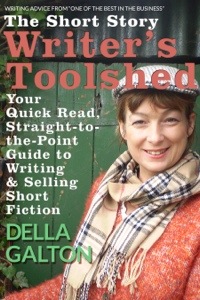
If you found that useful, (i know i did!) nip over to Amazon where you can download Della’s eBook The Short Story Writer’s Toolshed – Your Quick Read, Straight-To-The-Point Guide To Writing and Selling Short Fiction (Writer’s Toolshed Series)

20121205-161740.jpg

Originally written as a series for Writers’ Forum Magazine, this snappy, no-nonsense guide has been expanded, amended and updated. Using new examples from her own published short fiction, Della Galton takes you from ‘story idea’ to ‘final edit’, and demonstrates how to construct and polish the perfect short story, ready for publication.

Ahhhh, yes, repitition lol….I have a HUGE problem with that. Did any of those tips strike a chord (CLICHE ALERT lol) with you? 😉

Six Sentence Sunday 21st October


This weeks 6 sentences are from a piece I wrote as an exercise in the Faber class 🙂 We were asked to write 100 words on our name. I went blank, but after a bit of brainstorming came up with the idea of fictionalising the origin…..

We had agonised for days over what to call her.

“I want something classy Mike, you know, not Sharon or Tracey.”

Mike was very excited when he arrived at the hospital the following day and told me he’d found the perfect name for her, on a bus.

“I don’t think Waterloo is really suitable for a girl darling.”

But i was relieved to discover that he was referring to the number 36 going to Victoria Station.

Is it any wonder that she grew up loving the colour red!

This version has been edited down for the 6 sentences and yes, I really did get my name from a number 36 London bus 😉

If you want to see a actual number 36 bus the same as my dad would have seen you’ll have to click here.

20121020-182644.jpg
Is there a story in how you got your name?

Six Sentence Sunday 30th September


This weeks six sentences come from a prompt I did earlier on in the week 🙂

Stuart had never really liked women, it all went back to his childhood, his mother. The contempt she felt for him was evident in her daily actions. The way she spoke to him, the way she looked at him.

As a young adult he was convinced that women were not to be trusted. That they would lie and cheat to get what they wanted. Numerous relationships he purposely sabotaged, incapable of loving, incapable of accepting love.

20120926-205525.jpg
image curtesy of chrisroll/freedigitalimages

Awwwww, poor Stuart 😉

Ok, I need a happy ending for this one don’t I 🙂

The Long & The Short Of It – How Learning My Craft Has Changed My Life


Today, I’m guesting over at Sue Howe’s blog The Long and The Short Of It 🙂

Sue asked me if I could do an article about writing workshops, classes and residential schools. I’m trying to convince her to come along to Swanwick you see 😉

So here’s the start of the article…..to read more you’ll have to nip over to Sue’s gaff 🙂

A huge thank you to Sue for inviting me onto her Blog today….I don’t think she realised that when I’m enthusiastic about something, I can ramble for hours!

So Sue’s asked me to convince her of the merits of creative writing courses, classes and workshops. I’m hoping that by the time she reads this she’ll be enrolling on everything she comes across!

My first experience of “creative writing” was a baptism of fire. I decided (through madness or stupidity, I still don’t know which) to accompany a friend to a course at our local Adult Education centre. I hadn’t written any fiction since leaving school (many, ahem, years ago) although I had been journal writing for several years. That was exactly 2 years ago this month, and it was one of the best decisions of my life! I’ll be honest; the course itself was a little boring. I found myself nodding off in several sessions! But somehow, through all the yawning something clicked. Something happened to me during that short course, and it’s been driving me on ever since.

20120923-173557.jpg

Please pop over to Sues blog to read the rest of the article, and leave a comment. Tell her Sue, you have to go to Swanwick next year! 😉 Actually, thinking about it, you all have to come! 😉

Priceless Gift


This is the piece I wrote in response to the photo prompt of the locket on Saturday 🙂

Hope you like it, and any suggestions, or comments are as always, gratefully received.

Sophia sat with her back pressed firmly against the chair and watched, with a blazing jealousy, the scene in front of her.

Did he know she would be here today? Was that why he’d brought that whore here? To make her jealous?

She lifted her coffee cup and took a sip, her eyes fixed on the table in the corner.

James looked good, but then he always did. He playfully flicked a strand of hair from his companions face. Sophia felt instantly sick. She thought about where that hand had been. The parts of her he had explored with his fingers only last week.

Feeling the anger rising in her chest, pushing hatred into her throat she took another mouthful of coffee. But it was no use, no amount of sweet hot liquid would be able to eradicate the bitter taste that had developed in her mouth.

Clutching the gold locket at her neck she glared at the slim attractive women who was now laughing. Willing her to turn around, but she was too engrossed in James. Too caught up in lust to be aware of anyone else in the cafe.

James fumbled in his jeans pocket as his guest rose to her feet. Sophia grabbed her bag and flung it over her shoulder, shifting to the edge of her seat.

The red head kissed James on the cheek and tottered on her six inch heels in the direction of the ladies. With head down, Sophia stood, and followed her into the toilets.

20120919-104627.jpg

Oh come on, you know I don’t do happy? Did you really expect anything else? Lol 😉

In my mind I was thinking along the lines that Sophia is one of those women who James can pick up and put down whenever he wants, a shag buddy, but in his eyes, nothing more. She’s not slim and attractive, but she is available. Lets face it, Sophia is in love with him, and in her eyes, its not his fault, its all these gorgeous women who keep throwing themselves at him. James bought her the locket as a gift out of guilt, Sophia thinks that it means they have a future, if only these other women would leave him alone. But the question is……

What does she intend to do in the toilets? 😉

Six Sentence Sunday 23rd September


Here are my six sentences 🙂

Douglas ran his fingers through his chestnut brown curls and sighed.

“But you promised Douglas.” Nancy whined.

“I know, I know, but what do you expect me to do love?”

“Yeah, yeah, whatever, I hate this place!”

Douglas winced as Nancy stormed from the kitchen, slamming the door and stomped up the stairs.

Awwwww, poor Douglas lol. Nancy is one of them trophy wives, and when she doesn’t get her way, Douglas ends up on the sofa lol. She wants one of those swanky new apartments down on the river, but Douglas is running out of dosh, and fast…..she’s bleeding him dry.

20120912-114153.jpg
So what should Douglas do? Which in my reckoning probably isn’t what he will do 😉

New York New York


This is the piece that I wrote for the photo prompt I posted last Saturday 🙂

Stefano arrived in New York with 50 dollars in his pocket, a back pack and a small scrap of paper, on which his Mama had written his uncles address.

He soon found the restaurant, Casa Mia, along a road filled with Italian Deli’s, shops and Cafe’s. He pushed open the heavy oak door.

“Stefano!” An elderly man with white hair rushed towards him and enveloped him in a welcoming embrace.

“Uncle Roberto?”

“My boy, my boy, si, si.”

Stefano returned the hug and began to talk in Italian, but Roberto held up his hand.

“No Stefano, English, we is in America now.”

“Sorry uncle, you received Mama’s letter?”

“Yes, yes, please, sit.” Roberto put his arm around Stefano’s shoulders and guided him to a chair. As he sat down opposite he shook his head.

“Such a catastrophe, such a sad event that you should come here.”

Stefano hung his head, he could feel the tears pricking his eyes.

“Your father was a good man, yes? A good man for my sister.” He sighed. “But, this has brought you to me, yes? Your Mama says you can cook?”

“I…err…well, a little uncle.”

Roberto laughed. “Ahhhh…no more farming for you Stefano. Now, you come to America, be famous chef, yes?”

It was now Stefano’s turn to laugh. “We’ll see uncle, we’ll see.”

20120912-105158.jpg
photo courtesy of Carlos Porto/freedigitalphotos

I have a bit of a thing about Italians, have you noticed? Lol 😉 Must be something to do with my Italian blood (my great grandparents were Italian Trapeze artists….how cool is that?).

Anyway, I like Stefano, I think this one could definitely end up a very happy story (that makes a change!!!!!!). I’m thinking Stefano turns out to be an excellent chef and really turns the restaurant around. But his cousin (Giovanni) is not happy (bit of conflict is always good)
and is worried that Roberto will hand the business over to Stefano (as he’s getting a bit too old to run the place). What actually happens in the end is anyone’s guess 😉

But, how did the dialogue seem? Any tips to getting across an Italian accent would be much appreciated 🙂

Edited to add commas as per Dianne’s suggestion – See below

Six Sentence Sunday 16th September


Today is Six Sentence Sunday!

I’ve finally managed to get my link up on the site so this week I am participating officially! 🙂

Still experimenting with first person POV, and d’ya know what? I’m really enjoying it 🙂

In my first life, when I lived in France, my bed was straw. In my second life, in Italy, I laid on a large white bed, surrounded by vases of flowers, my body draped in the finest silk. Now, in what I call, my third life, I am a prisoner in a two up two down tiny terraced house in a small town in Northern England.

I don’t mind the cold and the rain, i was expecting that. But what I wasn’t expecting was how much John would change. I’m trapped and he has my passport.

This was part of a piece that a wrote about a poor French girl who tries to better herself. Unfortunately, in Italy she meets a man who, after promising her the earth, whisks her back to England to a life of misery (he turns out to be a right nasty bit of work!).

20120912-102105.jpg
photo courtesy of Darren Robertson/freedigitalphotos

Poetic justice for being greedy? Or will the Italian Stallion come to England to rescue her?

On The Pull


Nooooo, not me, I’m a married women…..but then so is she 😉

This is the piece I wrote that was inspired by the “powder room” photo on Saturday 🙂 In first draft, I’m still experimenting with first person POV.

“Quick, hold the door and keep watch.”

“But Sara, I can’t physically stop people coming in?”

“Yes you can, go on, stand in front of the door.”

I rested my weight against the door and tried to focus my attention on the flock wallpaper rather than my friend, stripping down to her bra and knickers.

“I don’t know why we have to go through this every time. You looked fine.” I muttered under my breath.

Sara laughed as she pulled up the scarlet Lycra mini dress.

“Oh please, you know if Dave saw me going out like this he’d kill me!”

I had to admit she was right. Sara’s husband was possessive. She was only allowed to see me once a month and as far as he was concerned you didn’t need to dress up for Bingo. But then, he didn’t know that we never actually went.

Sara folded her jeans and T shirt and placed them in her bag. She was already wearing high heels, Dave loved her in stilettos.

“Right, all done, just the makeup.” She twirled “How do I look?”

I wanted to say like a whore, but I bit my tongue. It wouldn’t have worried her anyway, that was the look she wanted.

“Great, very sexy.” Well, it was partly true.

She quickly applied some more makeup and pouted her blood red lips.

“Now, just a little something to get me in the mood.” She winked and laid a small mirror on the shelf above the sink. I bowed my head and listened to her snorting.

“Do you have to do that in a place like this?”

“Oh, stop being such an old woman Chlo. Right, let’s go get em.” She shrieked with laughter and as she leaned over my shoulder to the door handle, she paused. “and don’t forget, if I pull, I’ve stayed at yours tonight.”

I smiled, I knew the drill.

20120803-083027.jpg

Hmmmmm, not too sure where that one is going. Perhaps tonight, Chloe will tell Dave the truth?

I’m open to suggestions?